← All research

Phishing Techniques Research for Hunting Development

Analysis of recent phishing campaign tradecraft, attack vectors, TTPs, and hunting development guidance

Executive Summary

Recent phishing campaigns increasingly abuse trusted identity and collaboration workflows rather than relying only on fake credential pages. The most important shift is from credential theft to session and token theft, followed by cloud API misuse for mailbox and SaaS data collection.

For hunting development, behavior-based detection should be prioritized over campaign-specific indicators. Correlated detections across email, identity, endpoint, and cloud telemetry produce higher confidence and stronger resilience against rapid attacker infrastructure rotation.

Scope and Method

This report synthesizes publicly documented campaigns from 2024 through 2026, with emphasis on:

  • Device code phishing
  • Adversary-in-the-middle phishing kits
  • OAuth consent and client identity abuse
  • QR phishing and staged redirect chains
  • ClickFix command-paste phishing and fake verification lures
  • Teams and phone social engineering with remote support abuse
  • Rogue RDP attachment lures

Campaign Snapshot

Campaign or Cluster Timeframe Primary Targets Core Technique Pattern Hunt Priority
Storm-2372 device code phishing 2024 to 2026 Government, NGO, IT, defense, telecom, health User lured to legitimate device sign-in flow, token theft and mailbox access Critical
Multi-stage code-of-conduct AiTM campaign 2026 Broad enterprise, heavy US targeting PDF lure, CAPTCHA staging, token interception Critical
Tycoon2FA ecosystem 2025 to 2026 Cross-sector Phishing as a service, session cookie and token theft Critical
OAuth client identity spoof campaigns 2025 to 2026 Cloud and SaaS users Missing app identity, spoofed client IDs, consent abuse High
ClickFix campaigns and kits 2024 to 2026 Enterprise users, finance, government, education, general endpoints Fake verification or troubleshooting prompt drives user-run command execution Critical
Teams vishing with email bombing 2025 to 2026 Enterprise service desks and end users Mail flood, impersonated support, remote control takeover Critical
Rogue RDP lure campaigns 2024 to 2025 Government and military sectors Signed or trusted-looking RDP attachment abuse High

Dominant Attack Vectors

Vector What Changed Recently Why It Matters for Hunting
Link-first phishing High volume link delivery now dominates large telemetry sets URL click correlation is foundational
Device code phishing Legitimate sign-in endpoints used as social engineering anchors Traditional domain block logic alone under-detects
AiTM session hijack MFA bypass by stealing authenticated session context Post-auth anomaly hunting is mandatory
OAuth abuse App consent and token trust paths abused for persistence and exfiltration Cloud app and identity joins become critical
QR phishing Rapid growth with attachment-to-QR lure staging Attachment and click telemetry correlation needed
CAPTCHA-gated pages Multi-stage anti-analysis and anti-scanning behavior Redirect-chain and browser telemetry improve fidelity
ClickFix command-paste lures Fake CAPTCHA, fake error dialogs, and human verification trick users into launching native tools Endpoint process, registry, and script telemetry are high value
Teams and phone vishing Human-operated intrusion paths with remote assist tools Identity plus endpoint process chains are strong signals

TTP Map for Query Engineering

ATT&CK Technique ID Confidence Evidence Pattern to Hunt
Spearphishing Attachment T1566.001 High PDF, HTML, SVG, DOCX, RDP lures tied to risky follow-on activity
Spearphishing Link T1566.002 High Click events leading to staged redirect and suspicious sign-in
Voice Phishing T1566.004 High External support impersonation and rapid remote tool usage
User Execution T1204 High User-triggered click, code entry, or remote session acceptance
Steal Application Access Token T1528 High Device and OAuth token misuse patterns
Use Alternate Authentication Material T1550 High Session cookie and token reuse from anomalous contexts
Valid Accounts T1078 High Authenticated cloud activity with abnormal context
Remote Email Collection T1114.002 High Mail API-heavy access and export behavior
Account Manipulation T1098 Medium to High Inbox rules, MFA changes, persistence actions
PowerShell T1059.001 High ClickFix and post-phish download chains commonly invoke PowerShell
Visual Basic T1059.005 Medium to High ClickFix follow-on stages frequently use VBS loaders and scheduled execution
Signed Binary Proxy Execution T1218 Medium mshta, rundll32, msbuild, regasm, and similar LOLBins are common execution pivots
Scheduled Task T1053.005 Medium to High Hidden task creation appears in documented ClickFix follow-on chains
Exfiltration Over Web Service T1567 High API and cloud channel data export spikes
Remote Services RDP T1021.001 High RDP file lure to suspicious endpoint execution

Attack Flow Details

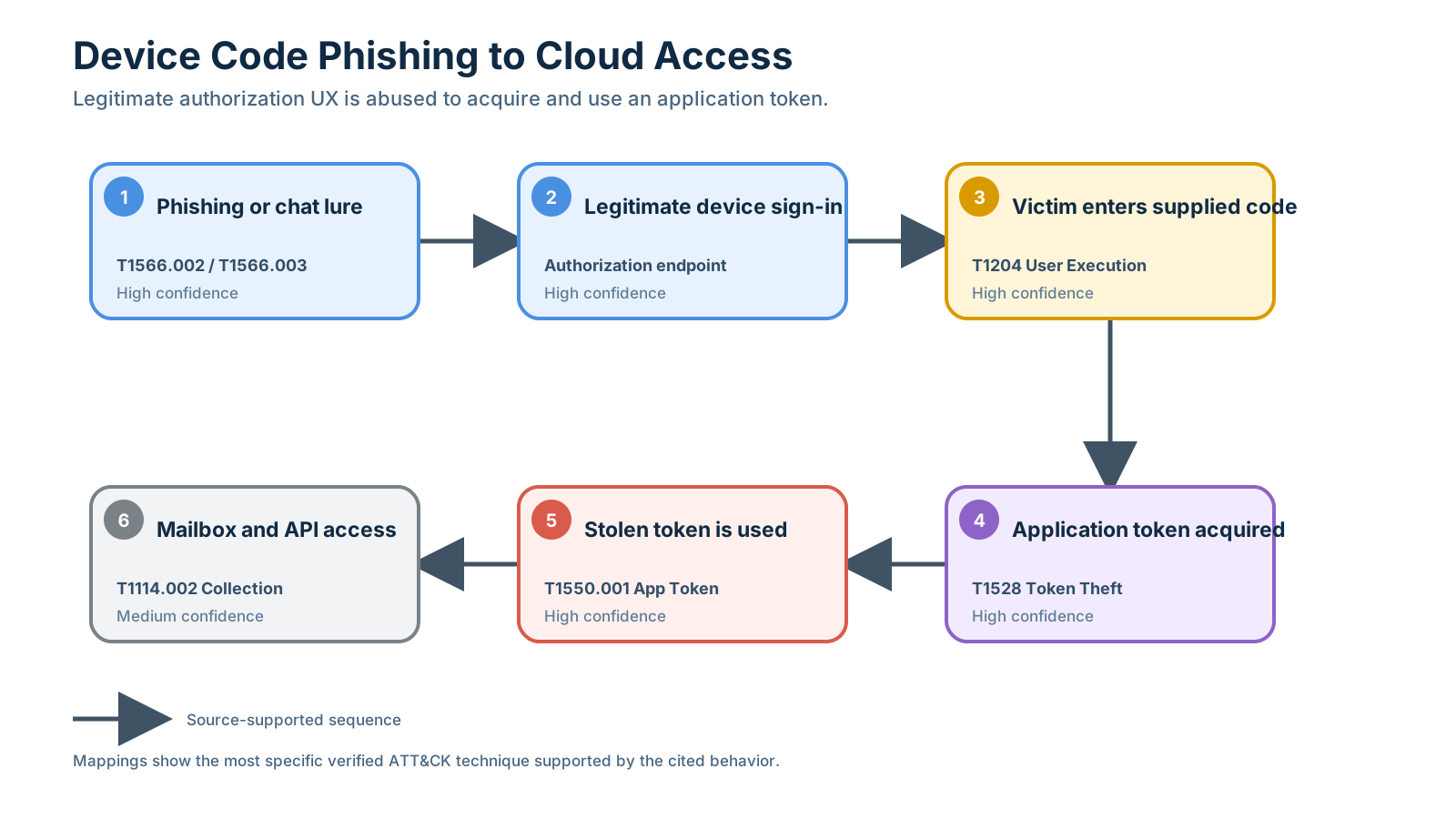
Flow A: Device Code Phishing to Cloud Data Access

Device code phishing flow from delivery through token acquisition and cloud access
Device code phishing abuses legitimate authorization flows to gain cloud access.

Flow B: AiTM Credential and Session Interception

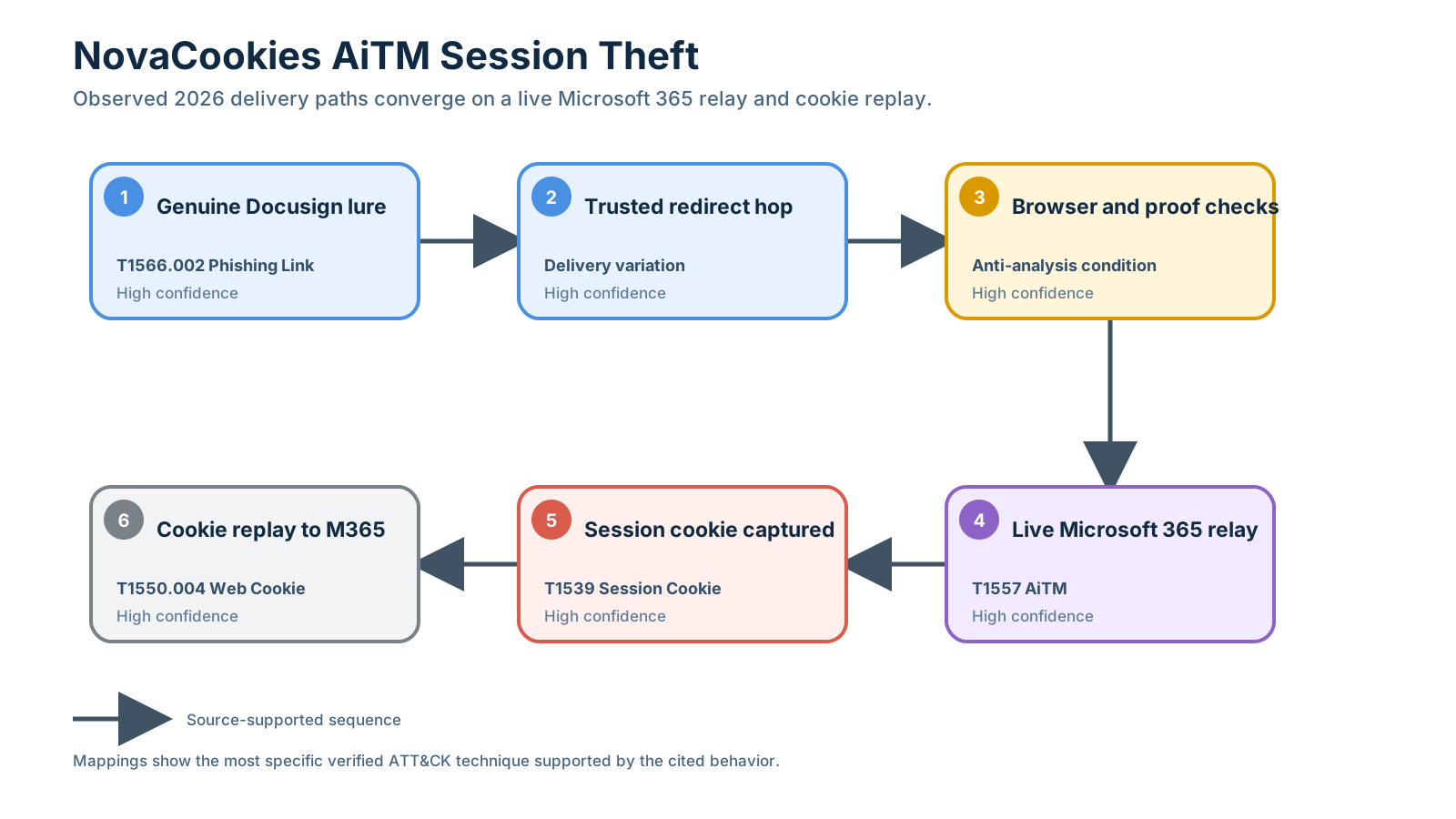
Adversary-in-the-middle phishing flow from lure delivery through session cookie replay
NovaCookies delivery paths converge on a live Microsoft 365 relay and session replay.

Flow C: Email Bombing and Teams Vishing Intrusion

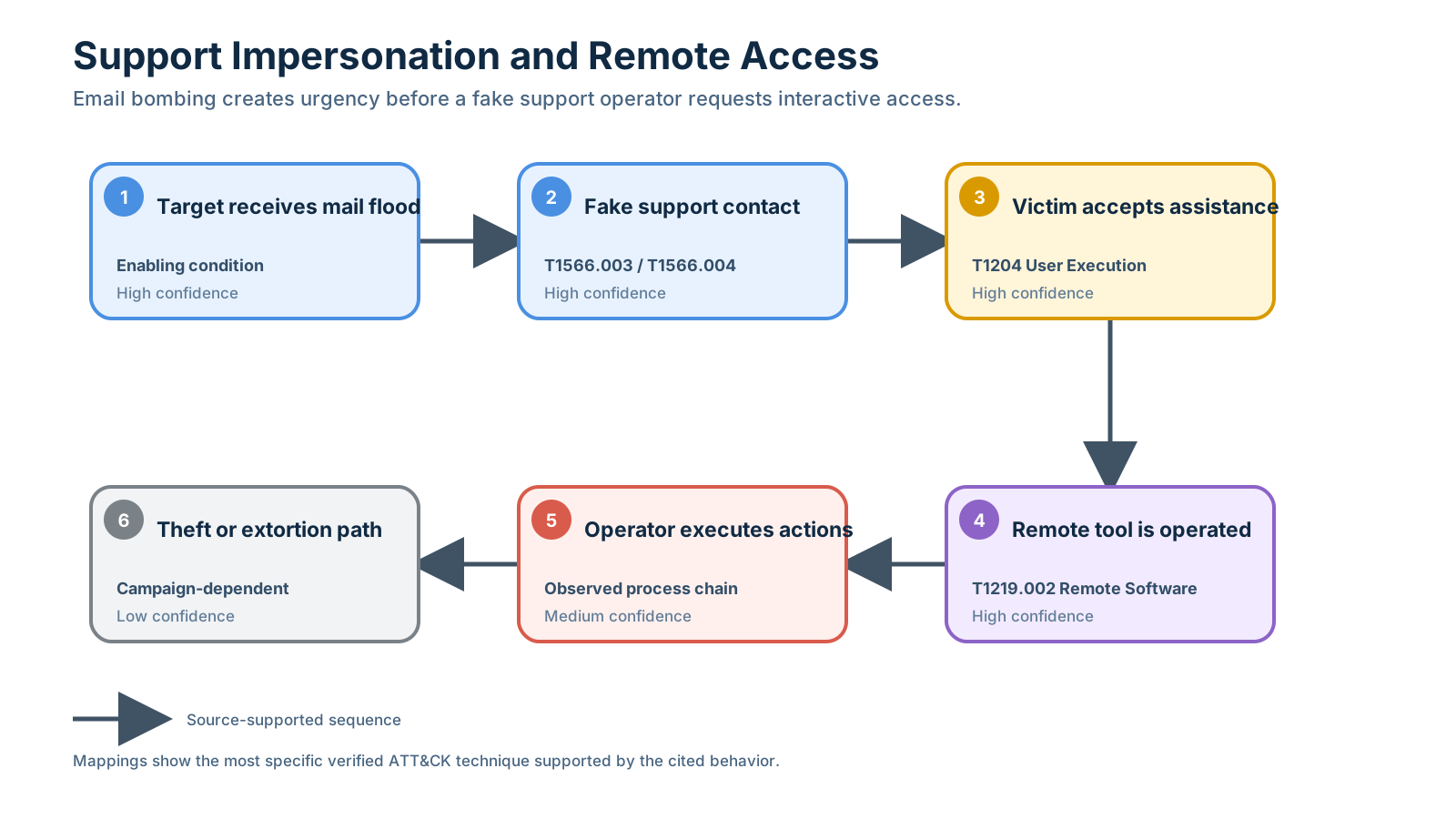
Support impersonation flow from email bombing through remote access and endpoint compromise
Email bombing creates urgency before a fake support operator requests interactive access.
flowchart TD
    A[Phishing Lure or Trusted App Pretext] --> B[User Opens Consent Link]
    B --> C[OAuth App Requests Permissions]
    C --> D[User Grants Consent to Malicious or Spoofed App]
    D --> E[Adversary Receives Access and Refresh Tokens]
    E --> F[API Access to Mailbox or SaaS Data]
    F --> G[Persistence Through Reusable App Trust]
    G --> H[Search, Collection, and Export Activity]

Flow E: ClickFix Fake Verification to Endpoint Payload Execution

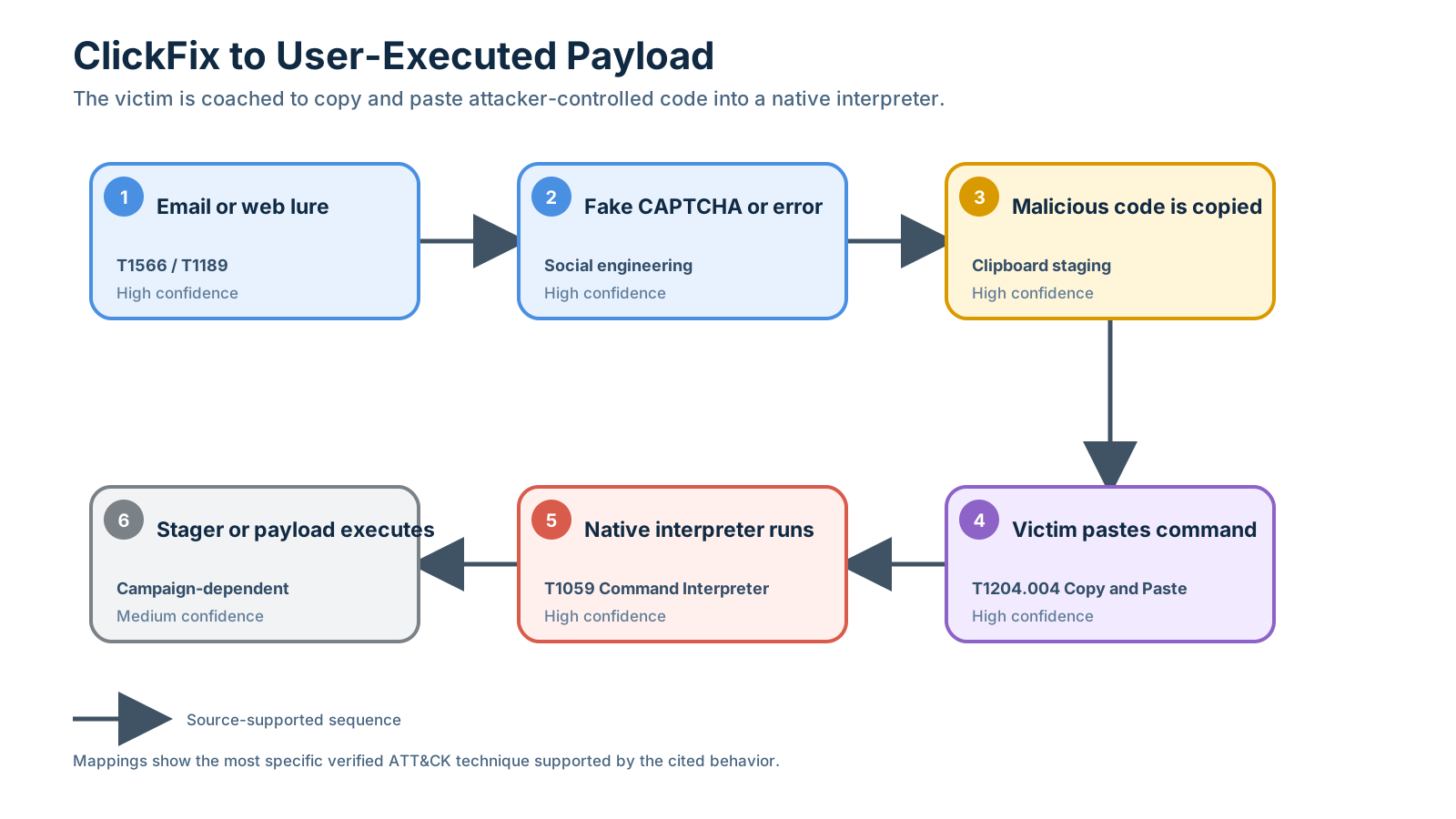
ClickFix flow from a fake verification prompt through user-executed code and payload delivery
ClickFix coaches the victim to paste attacker-controlled code into a native interpreter.

Flow F: Rogue RDP Attachment to Remote Session

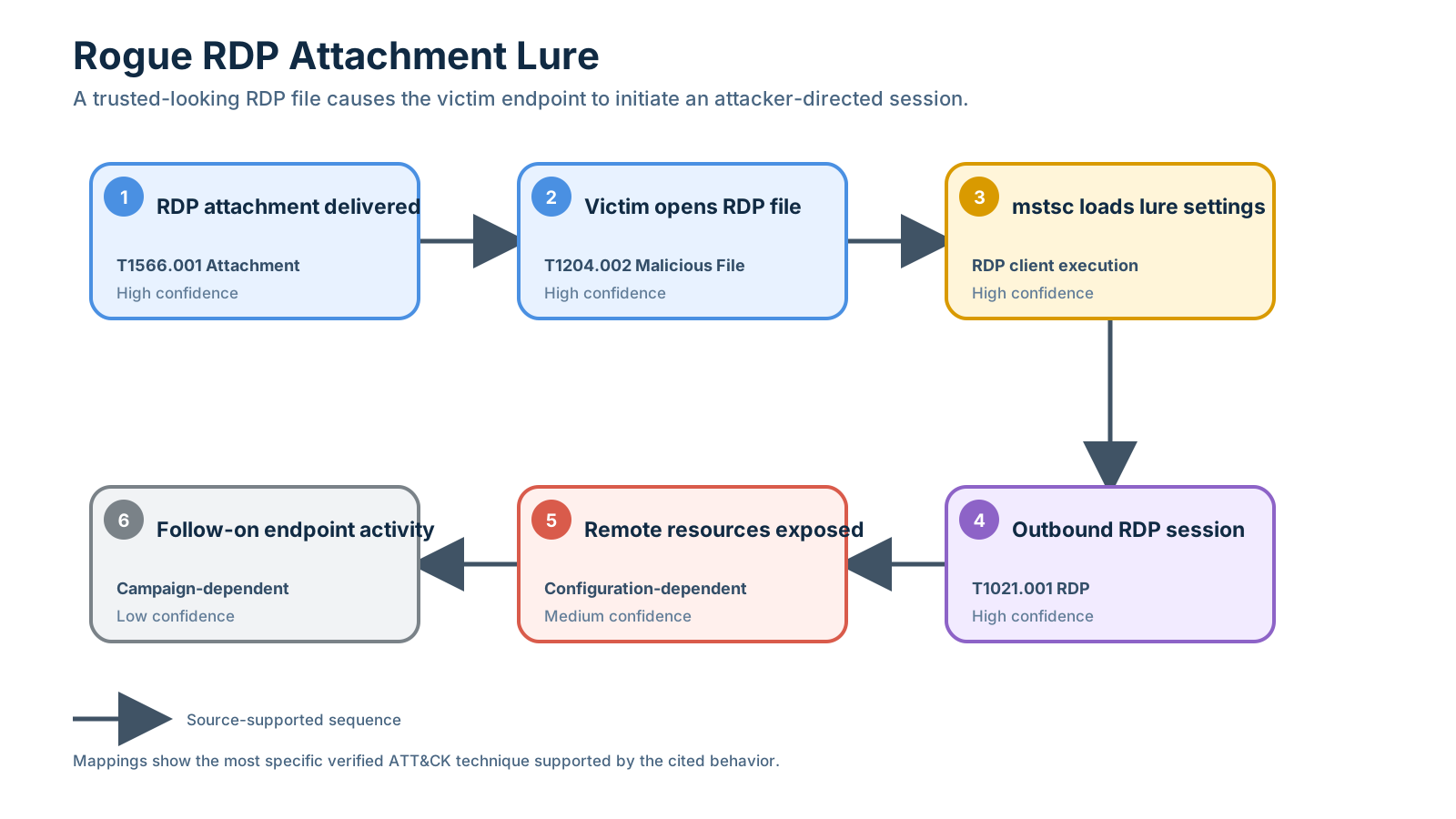
Rogue RDP attachment flow from phishing delivery through an attacker-directed remote session
A trusted-looking RDP file causes the endpoint to initiate an attacker-directed session.

ClickFix Research Findings

ClickFix is now a distinct phishing-adjacent social engineering technique rather than a niche variation of fake CAPTCHA delivery. The defining behavior is not the lure itself, but the deliberate transfer of execution responsibility to the user. Instead of relying on a browser exploit or direct file open, the adversary manipulates the user into pasting a command into Windows Run, PowerShell, Windows Terminal, or another trusted interface.

Microsoft observed the technique growing sharply from early 2024 through 2025, with campaigns delivering DarkGate, MintsLoader, Lumma Stealer, ScreenConnect, Lampion, and other follow-on payloads. Public reporting also showed state-aligned actors adopting the pattern, which matters because it demonstrates that ClickFix is no longer limited to commodity malware operations.

ClickFix Attack Characteristics

Stage Observed Pattern Hunting Relevance
Arrival Phishing email, malvertising redirect, or compromised website Email and web telemetry both matter
Lure Fake Cloudflare Turnstile, reCAPTCHA, browser error, Word error, or social platform verification Browser artifacts and landing-page themes can cluster campaigns
User coercion Clipboard copy plus step-by-step instructions to press Win+R or open Terminal Human-driven execution leaves distinct registry and process traces
Execution PowerShell, mshta, rundll32, wscript, curl, wget, cmd stacking, encoded commands Strong command-line and LOLBin hunting surface
Follow-on VBS, HTA, DLL, scheduled task, startup artifact, in-memory loader Persistence and staged payload correlation improve confidence
Payload objective Infostealer, RAT, loader, remote access tool, rootkit Maps to credential theft, remote control, and secondary malware risk

ClickFix-Specific Signals

Signal Type Examples from Research Defender and Sentinel Relevance
Clipboard-driven lure language Fake verification phrases such as human verification, Cloudflare check, or not-a-robot prompts Useful in HTML attachment, landing page, or user-reported phish analysis
Run dialog misuse Commands executed from explorer.exe with traces in RunMRU DeviceRegistryEvents and DeviceProcessEvents
LOLBin-heavy first stage PowerShell, mshta, rundll32, wscript, cmd, curl, wget DeviceProcessEvents and DeviceEvents
Obfuscation Base64, string concatenation, caret escaping, nested cmd and PowerShell chains Command-line regex and script block analysis
Script staging VBS in temp paths, renamed HTA or media-like extensions, hidden scheduled task creation DeviceFileEvents, DeviceProcessEvents, DeviceRegistryEvents
Network behavior Direct-IP retrieval, CDN or short-lived domains, suspicious TLDs, code-sharing or shortener use DeviceNetworkEvents and web session telemetry

Observable Signals by Attack Phase

Phase Observable Signals Defender and Sentinel Relevant Tables
Delivery Compliance, payroll, invoice, voicemail themes, attachment-heavy lure, QR embedding, ClickFix human-verification pretext, unusual sender local-part patterns EmailEvents, EmailAttachmentInfo, EmailUrlInfo, MessageEvents, MessageUrlInfo
Pre-auth Interaction URL redirects through cloud hosting, CAPTCHA stages, short-lived domains UrlClickEvents, EmailUrlInfo, MessageUrlInfo
Identity Compromise Interrupted then successful auth sequence, unusual app identity, anomalous source and user agent EntraIdSignInEvents, EntraIdSpnSignInEvents, IdentityLogonEvents
Session and Token Abuse Authenticated activity from mismatched device or network context, rapid cloud access after lure click EntraIdSignInEvents, CloudAppEvents, IdentityInfo
Persistence Inbox rule creation, MFA method changes, account manipulation CloudAppEvents, IdentityDirectoryEvents, IdentityInfo
Collection and Exfiltration API-heavy mailbox and SaaS export activity bursts CloudAppEvents, EmailEvents, ExposureGraphEdges
Operator-driven Endpoint Actions Quick Assist or remote tool process chains, suspicious script execution, RunMRU command traces, LOLBin download chains DeviceProcessEvents, DeviceEvents, DeviceNetworkEvents, DeviceRegistryEvents
RDP Lure Execution RDP attachment delivery followed by suspicious mstsc workflow EmailAttachmentInfo, DeviceProcessEvents, DeviceFileEvents

Hunting Development Framework

Priority Hypotheses

Hypothesis ID Hypothesis Statement Correlation Logic Priority
H1 Device code lure leads to suspicious authenticated access Url click to device-sign-in pattern joined to risky or unusual sign-in and rapid cloud activity Critical
H2 AiTM campaign leads to session hijack after successful MFA Phishing click plus successful sign-in plus anomalous post-auth behavior in cloud apps Critical
H3 OAuth client spoofing and consent abuse establish durable access Missing app identity or abnormal client ID patterns plus new consent grants plus API bursts High
H4 QR phishing campaign drives staged redirect compromise Attachment type and QR indicators plus click chain plus identity anomaly High
H5 Vishing chain causes remote support mediated compromise Email bomb pattern plus external support contact plus endpoint remote tool and script behavior Critical
H6 Rogue RDP lure initiates endpoint compromise Inbound RDP attachment plus endpoint RDP execution from suspicious path plus follow-on process anomalies High
H7 ClickFix lure results in user-executed native command chain Click or landing event plus explorer.exe initiated RunMRU update plus LOLBin or script execution plus suspicious network retrieval Critical

Query Building Blocks

Building Block Detection Intent Candidate Predicates
Lure Identification Detect suspicious phishing delivery Attachment extensions, sender pattern outliers, lure keyword clusters
Click Correlation Confirm user interaction Same recipient with click event in short time window
Sign-In Anomaly Surface credential or token misuse New geolocation, unusual user agent, interrupted then successful sequence
Consent and App Abuse Detect OAuth trust exploitation New app consent, high privilege scopes, blank app naming, client ID anomalies
Post-auth Cloud Abuse Detect data access misuse Sudden increase in read, search, export, or report operations
User-Executed LOLBin Chain Detect ClickFix-style execution explorer.exe parentage, RunMRU writes, PowerShell or mshta with encoded download behavior
Endpoint Follow-on Catch operator activity Remote assistance tooling plus scripting process lineage

Detection Engineering Notes

  • Prefer time-window joins across identity, email, endpoint, and cloud telemetry instead of single-table detections
  • Treat campaign-specific domains, IPs, and hashes as temporary enrichment only
  • Model normal user device and sign-in patterns to improve anomaly precision
  • Score detections using weighted evidence from multiple phases rather than binary matches
  • Add suppression for known enterprise automations and approved third-party SaaS integrations
  • For ClickFix, prioritize user-initiated execution traces such as RunMRU writes, explorer.exe parentage, clipboard-driven command artifacts, and encoded LOLBin execution

Suggested Content for Hunt Playbooks

Playbook Section Recommended Content
Trigger Condition Multi-signal threshold crossed across delivery, identity, and cloud activity
Triage Checklist Confirm lure interaction, validate sign-in context, inspect consent and token behavior
Scope Expansion Search for same sender infrastructure, same client IDs, same user agents, same redirect domains
Containment Actions Revoke sessions and tokens, disable suspicious app consents, reset credentials and MFA factors
Recovery Validation Confirm no recurring anomalous API or mailbox export behavior

Source References