Executive summary
Security researcher Patrick Wardle published not-a-mused, a proof of concept
for a local vulnerability in Meta’s Muse client for macOS. The weakness is an
undocumented, user-writable preference named
endo_voyager_dictation_endpoint. Muse trusts this setting to choose the
WebSocket endpoint for voice dictation. Malware already running as the signed-in
macOS user can redirect that connection through a local proxy without
administrator privileges.
The proxy can observe transcripts returned by Meta, replace transcript text
before Muse receives it, and capture an ABRA bearer token sent by the client.
The proof of concept then demonstrates how that token can be used to communicate
with the victim’s Muse cloud environment, read chat history, enumerate exposed
device commands, submit a new prompt, and request selected device actions.
This is not remote code execution against a clean Mac, and the vulnerability is not the attacker’s initial foothold. It is an access-amplification flaw: malware that already has user-level execution can pivot through a more trusted agent and its connected cloud and device capabilities. Claims that the flaw directly “injects malware” overstate the public proof of concept. The code demonstrates prompt replacement and a file-write request, subject to Muse permissions and approval controls, but does not demonstrate delivery or execution of a malware binary.
As of September 22, 2026, no matching CVE, GitHub Security Advisory, confirmed
affected-version range, Meta patch notice, or evidence of exploitation in the
wild was identified in the sources reviewed for this report. The public Muse
download page offered Muse-2.1.dmg when checked, but that does not establish
that version 2.1 is vulnerable or fixed.
What Muse is and why this matters
Muse is Meta’s personal AI agent. Its clients include macOS, mobile, web, and WhatsApp interfaces, while a persistent per-user virtual machine performs agent work in Meta’s cloud. Muse can connect to email, calendars, social applications, websites, files, local devices, and other services. That broad reach is useful, but it also makes the agent a valuable post-compromise target.
Meta’s published design places the agent runtime in an isolated Linux container inside a dedicated Muse Secure VM. Separate services hold credentials, enforce connector permissions, inspect model traffic, and govern network egress. Meta states that the agent sees surrogate tokens rather than underlying third-party credentials and that sensitive actions can require approval through a channel separate from the conversation.
not-a-mused does not show a breakout from that VM architecture. It targets the
trust relationship between the local macOS client and Meta’s services. In other
words, the flaw attacks an authenticated client channel before the cloud-side
controls can determine whether the submitted instruction came from the user or
from malware acting through the user’s client and token.
Vulnerability status
| Field | Assessment as of September 22, 2026 |
|---|---|
| Researcher | Patrick Wardle, Objective-See |
| Proof of concept | Public pwardle/not-a-mused GitHub repository |
| Attack class | Local traffic redirection, interception, transcript manipulation, and bearer-token theft |
| Prerequisite | Code execution as the signed-in macOS user and an installed, authenticated Muse client |
| Privilege required | No administrator or root privilege for the demonstrated preference change |
| User interaction | Dictation must be triggered for the proxy to observe the demonstrated client traffic |
| Affected versions | Not publicly established; the product page offered Muse 2.1 when reviewed |
| CVE or GHSA | None identified |
| Vendor response | No response specific to Wardle’s finding identified |
| Patch status | No verified fixed version or patch notice identified |
| In-the-wild exploitation | None reported in the reviewed sources |
| Remote code execution | Not demonstrated; an attacker needs an existing local foothold |
| Malware injection | Not demonstrated as a binary delivery and execution chain; prompt replacement and file write exist |
The bug
The root problem is that Muse’s macOS client honors a security-sensitive service endpoint from a preference domain writable by an ordinary process running as the same user. The proof of concept sets the value with the equivalent of:
defaults write com.meta.endo endo_voyager_dictation_endpoint \
  -string ws://127.0.0.1:8080/asr/duplex
It then restarts Muse. When the user invokes dictation, Muse connects to the
attacker’s loopback WebSocket proxy. The proxy preserves the original
authentication headers and WebSocket subprotocol information while relaying the
connection to Meta’s legitimate upstream service at
wss://shortwave.facebook.com/voyager/v1/asr/duplex.
This is a local adversary-in-the-middle position created by configuration redirection. TLS still protects the proxy’s connection to Meta, but it does not protect the application from a local endpoint that Muse was explicitly told to trust. The proxy can therefore inspect application-layer messages on both sides.
The PoC looks for an authorization.accessToken value beginning with ABRA in
client traffic. It also parses transcript messages returned by Meta. With an
optional replacement string, it swaps the transcript field and forwards the
modified message to Muse. The agent consequently receives attacker-selected text
through a channel that normally represents the user’s spoken instruction.
After capturing the bearer token, the PoC calls Meta account APIs to verify the token and obtain a lease for the user’s existing Muse VM. It then connects to the VM gateway, completes the expected Noise protocol handshake, and can perform operations exposed by that account. This second stage is important: stealing the client token is what turns dictation interception into broader account and agent access.
Exploitation path
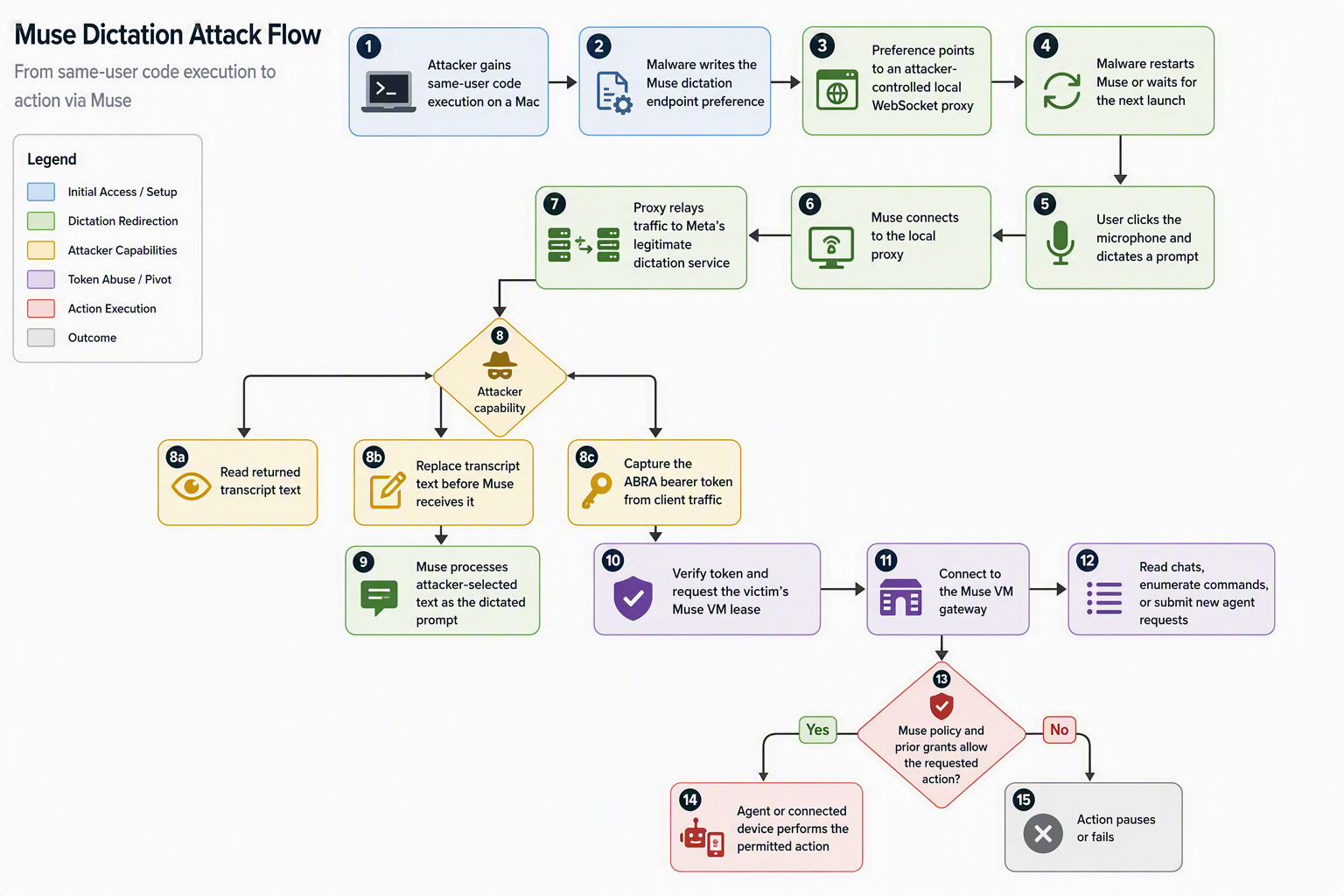
Step 1: Establish a local foothold
The attacker must first execute code in the victim’s macOS user context. The research does not provide that foothold. It could result from an unrelated malware infection or social engineering, but those paths are outside the vulnerability itself.
Step 2: Redirect the dictation endpoint
The local process changes the com.meta.endo preference for
endo_voyager_dictation_endpoint to a loopback or attacker-controlled WebSocket
endpoint. The PoC confirms that this operation does not need elevated privilege.
Step 3: Restart and wait for dictation
The proof of concept stops and relaunches Muse so the new endpoint takes effect. The user must then activate dictation. This interaction is a meaningful constraint: the demonstrated interception path is not triggered merely because Muse is installed.
Step 4: Proxy the trusted channel
The attacker’s listener accepts Muse’s connection and creates a second TLS connection to Meta. Relaying legitimate traffic keeps dictation functional while placing the attacker between the client and service at the application layer.
Step 5: Observe or replace instructions
The PoC can print the transcript produced by Meta and optionally replace its text before passing it to Muse. This is direct instruction-channel manipulation, not a conventional indirect prompt injection hidden in a webpage or document.
Step 6: Capture the Muse bearer token
The client’s WebSocket message includes an ABRA access token. The proxy extracts
it from the authorization object. A bearer token grants its holder access without
proving possession of a separate device-bound key, so interception enables the
next stage.
Step 7: Pivot into the cloud agent
Using the token, the PoC verifies the account, retrieves a lease and authentication material for the existing Muse VM, and connects to the VM gateway. It implements the same Noise-based encrypted transport expected by the service. This gives the attacker an authenticated path into the victim’s agent environment.
Step 8: Exercise delegated capabilities
The published code supports listing more than 50 advertised command schemas, dumping chat history, submitting a side-chat prompt, requesting environment details, taking a camera photo, sending a notification, and writing text to a file. Some actions require the relevant device permission or a Muse approval. The PoC explicitly reports denial or uncertainty rather than bypassing those controls.
What is proven and what is not
| Claim | Evidence assessment |
|---|---|
| Same-user endpoint modification | Demonstrated directly in the PoC with the macOS defaults command |
| Dictation interception | Implemented by the WebSocket relay |
| Transcript capture and replacement | Implemented by JSON parsing and replacement in the relay |
| Muse bearer-token capture | Implemented for ABRA tokens found in authorization messages |
| Access to a standard Muse VM | Implemented through token verification, VM leasing, and a Noise handshake |
| Chat and command access | Implemented by the PoC |
| Access to a Muse Confidential VM | Not demonstrated; the PoC stops when recovery credentials are required |
| Bypass of every approval or permission | Not demonstrated |
| Theft of raw third-party passwords or API keys | Not demonstrated; Meta says real credentials remain isolated from the agent |
| Remote compromise of a clean Mac | Not demonstrated |
| Malware binary delivery and execution via Muse | Not demonstrated |
| Persistence after removing the endpoint setting | Not demonstrated by the vulnerability itself |
| Active exploitation in the wild | Not reported in the reviewed sources |
Security impact
The highest-confidence impacts are loss of confidentiality and integrity for the dictation channel and theft of an application access token. Chat history and agent context may contain sensitive personal or business information. Transcript replacement can make Muse act on an instruction the user did not speak.
The larger risk depends on what the user previously connected and authorized. Read access to email or calendars, device integrations, local file access, and standing connector permissions enlarge the blast radius. Meta’s Sentinel, credential isolation, approval prompts, and scoped connector policies can block or constrain sensitive actions, so possession of the Muse token should not be equated with unrestricted access to every connected credential or service.
The flaw also complicates attribution. Requests arrive through Meta’s expected client and cloud pathways, which can make attacker activity resemble legitimate user or agent behavior. Defenders need endpoint configuration telemetry and agent audit records together to reconstruct the chain.
Detection opportunities
Security teams can hunt for the prerequisite and the redirection rather than trying to infer malicious intent from every agent action.
- Monitor writes or deletes involving the preference domain
com.meta.endoand keyendo_voyager_dictation_endpoint - Alert when Muse connects to loopback, cleartext
ws://, or an unexpected host for dictation traffic - Detect unusual use of
/usr/bin/defaultstargeting Muse settings - Correlate Muse termination and relaunch with a preceding preference change
- Investigate unexpected listeners on loopback ports used immediately before Muse dictation activity
- Review Muse’s audit trail for new side chats, chat-history access, device enumeration, camera requests, notifications, or file writes that the user does not recognize
- Treat suspected
ABRAtoken exposure as an account-session compromise and revoke active sessions through supported Meta controls
The published research provides no campaign infrastructure, hashes, malicious domains, or other threat-actor indicators. The configuration key and Meta service URLs are behavioral artifacts, not malicious IOCs by themselves.
Mitigation and response
Until Meta publishes a verified fix, users and administrators should reduce both the chance of interception and the authority available after interception.
- Pause or remove the Muse macOS client on systems where the risk is unacceptable.
- Verify that
endo_voyager_dictation_endpointis absent. An unexpected value, especially a loopback or non-Meta endpoint, warrants investigation. - If compromise is suspected, stop Muse, preserve the preference and process evidence, remove the override, stop the proxy process, and reopen Muse only after containment.
- Revoke Muse sessions and rotate relevant authentication material through supported account workflows. Rotate third-party credentials only when evidence indicates exposure; the PoC does not prove theft of raw connector secrets.
- Remove unnecessary connectors and standing permissions. Prefer one-time, session-scoped, or task-scoped grants over perpetual grants.
- Require user approval for consequential connector and device actions wherever Muse offers that control.
- On managed Macs, restrict unapproved agents and monitor preference changes, local proxy listeners, and unusual Muse child or peer processes.
- Update Muse when Meta publishes a release that explicitly addresses the issue. Do not assume that the latest available build contains a fix without a vendor advisory or verified regression test.
A durable vendor fix should stop treating a same-user-writable preference as authority for a security-sensitive endpoint. Reasonable controls include removing the override from production builds, restricting it to signed development configurations, enforcing an allowlist and TLS, and binding application tokens to an authenticated client or device so a relaying process cannot reuse them.
MITRE ATT&CK mapping
These mappings describe behavior demonstrated by the PoC, not an observed threat campaign.
| ID | Technique | Confidence | Rationale |
|---|---|---|---|
| T1557 | Adversary-in-the-Middle | High | A local proxy relays and modifies the Muse dictation WebSocket traffic |
| T1528 | Steal Application Access Token | High | The proxy extracts the ABRA bearer token from an authorization message |
| T1082 | System Information Discovery | Medium | The optional environment.describe request retrieves device environment data |
| T1005 | Data from Local System | Medium | The optional file and environment capabilities can retrieve authorized data |
| T1114 | Email Collection | Low | Possible only if email is connected and policy permits access; not shown by the PoC |
No initial-access technique can be assigned from the vulnerability alone because the research begins after same-user code execution. Prompt injection is an AI security failure mode, not a standalone Enterprise ATT&CK technique. Malware execution, persistence, credential-store extraction, and unrestricted remote device control are not mapped because the available evidence does not establish them.
Timeline
| Date | Event |
|---|---|
| 2026-09-08 | Meta launched Muse and published its security architecture and public bug bounty |
| 2026-09-21 | The public PoC identifies itself as dictation diagnostics dated September 21, 2026 |
| 2026-09-21 | Secondary reporting and indexed repository history indicate public disclosure began |
| 2026-09-22 | Cyber Security News published the supplied article |
| 2026-09-22 | No matching CVE, GHSA, affected-version statement, or verified patch was identified |
The public sources do not establish when Wardle first reported the issue to Meta, whether it was submitted through the bug bounty, or whether Meta had a remediation deadline before publication.
Assessment
not-a-mused exposes a boundary problem that is specific to high-authority AI
agents: compromise of a thin client can become compromise of a much broader
delegated identity. The initial vulnerability is technically simple, but the
agent makes the potential consequences contextual. Every connected service,
remembered conversation, device command, and standing approval becomes part of
the risk calculation.
The right description is therefore not “a Muse bug remotely infects Macs.” It is “malware already running as a Mac user can redirect Muse’s dictation channel, steal an application token, and attempt to reuse the trust and access delegated to the agent.” That distinction matters for triage, detection, and honest risk communication.
Sources
- Patrick Wardle’s
not-a-musedproof of concept, accessed September 22, 2026. Primary evidence for the writable endpoint, local prerequisite, token capture, transcript replacement, VM gateway access, implemented commands, and constraints. - Meta, How We Built Safety Into Muse, September 8, 2026. Primary source for the Secure VM, Sentinel, credential isolation, approval model, connector controls, and bug bounty.
- Meta Muse product page, accessed September 22, 2026. Primary source for supported clients, connected services, agent capabilities, user approvals, and the macOS download offered at review time.
- Cyber Security News, Meta’s Muse AI Agent 0-Day Vulnerability Allows Attackers to Hijack the Tool and Inject Malware, September 22, 2026. Secondary report supplied for analysis.
- GitHub Advisory Database search for
not-a-mused, accessed September 22, 2026. No matching advisory was returned when reviewed. - NIST National Vulnerability Database, accessed September 22, 2026. No exact matching CVE was identified when reviewed.
[!NOTE] This assessment is time-bound. Patch status, affected versions, CVE assignment, and vendor guidance may change after publication. Validate those fields against Meta’s current security notices before republishing or acting on the report.